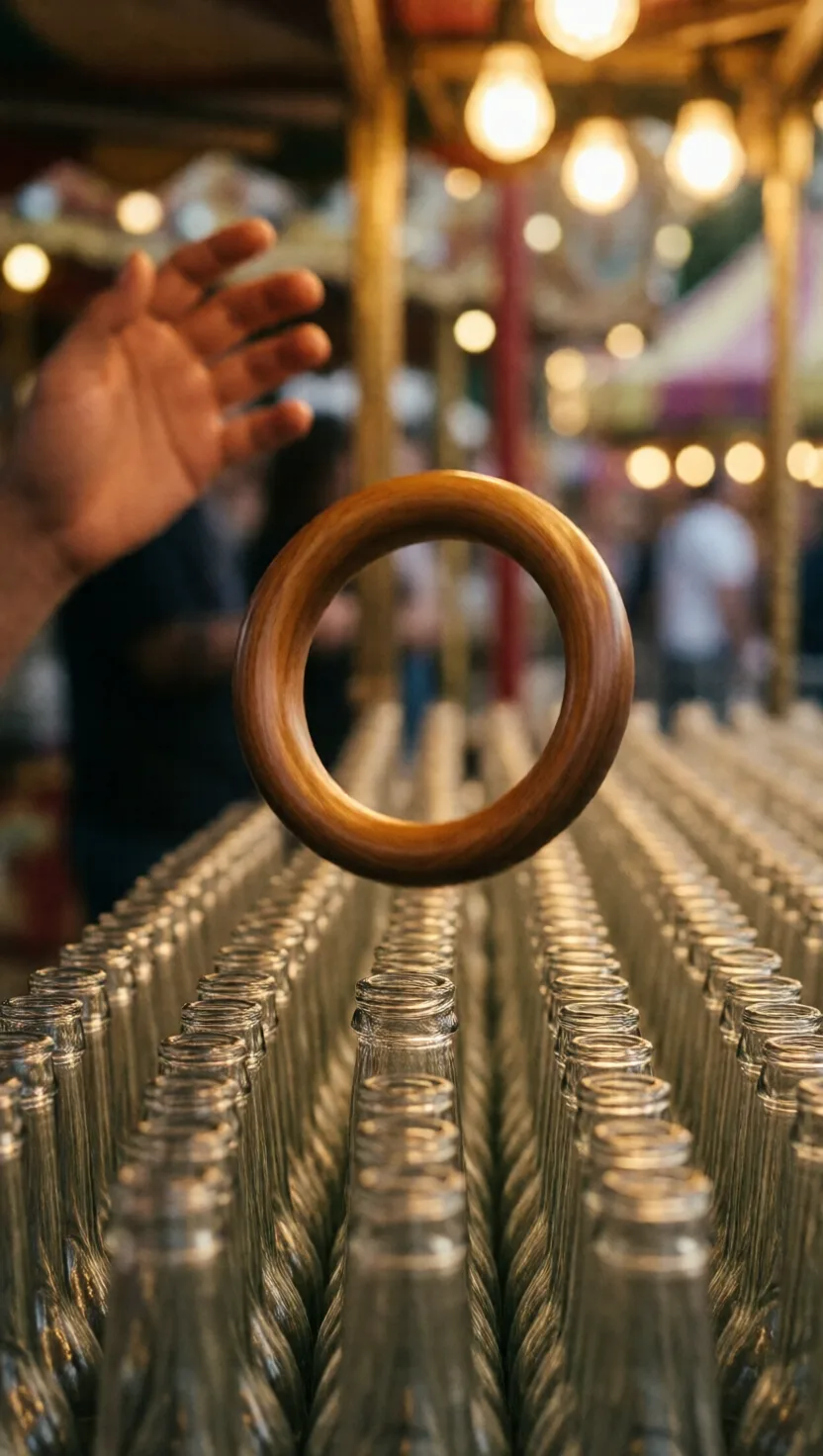
One ticket, a thousand imagined throws.

SRC·89 Source
Her last ticket, and a game that won't say what it costs

Her last ticket, and a game that won't say what it costs

Mara has one ticket left, and the ring-toss booth is glowing. She just watched a boy carry off a bear bigger than he is — and, before him, twenty players walk away with nothing. So is the game generous or greedy? One throw is either jackpot or empty air. What is a single throw of chance actually worth?
Watching five throws tells her almost nothing

Watching five throws tells her almost nothing

She decides to watch before she spends. Five throws: one winner! The game looks kind. Ten more: nothing but groans. Now it looks cruel. A handful of tries swings wildly — the same booth can look broken or blessed in a single evening. Her eyes need more plays than one night can hold. So she closes them, and starts to imagine…
A thousand imagined plays melt into one number

A thousand imagined plays melt into one number

In her head she runs the booth all summer. About one throw in fifty wins, and the bear is worth thirty tickets. So in a thousand throws: twenty bears, six hundred tickets back — for a thousand spent. Spread evenly, each throw returned about 0.6 of a ticket. Rare jackpots and heaps of misses, melted into one steady number. But what kind of number is that…?
Chance has a balance point

Chance has a balance point

E[X]=xxp(x)E[X] = \sum_x x \cdot p(x)
Her number has a shape. Lay a plank. At zero, pile forty-nine parts of chance — the misses. At thirty, set one slim part — the bear. The plank balances at 0.6. That's all the formula says: multiply each outcome by its share of chance, add them up — and you get the game's balance point. She's about to learn its name — right after one honest warning.
No single throw ever pays the average

No single throw ever pays the average

Here's the warning: no throw will ever hand her 0.6 of a ticket. Every real throw pays thirty or nothing. The balance point is a number no single play produces — its promise lives in the long run, where the average of many throws settles toward it. The booth gets that long run: a whole summer of players. Mara gets one throw. So what is the number to her?
The balance point has a name: expectation

The balance point has a name: expectation

The number is the expectation — every outcome weighed by its chance, summed into the fair price of one play. Now the whole fair snaps into focus: each booth is priced so its expectation sits below the ticket. The games don't need luck; they own the long run. Mara knows what her ticket buys: 0.6 tickets of value, plus a chance at a bear. The choice is hers now…
🌱 What is the average of a chance you take once?

🌱 What is the average of a chance you take once?

She throws — for the joy of it, knowing the price — and the ring skips off, and it's fine. Walking home, she wonders about bigger throws. Expectation prices what you'd get across a thousand replays. But a first job, a move to a new city, a confession — some throws come once, with no long run to settle into. What does the average mean, when there is only ever one throw?
tap →swipe ↑ for depthswipe ↓ to exit