
How raw scores become slices of one shared pot.

SRC·82 Source
One pot of prize money, and a strange way to split it

One pot of prize money, and a strange way to split it

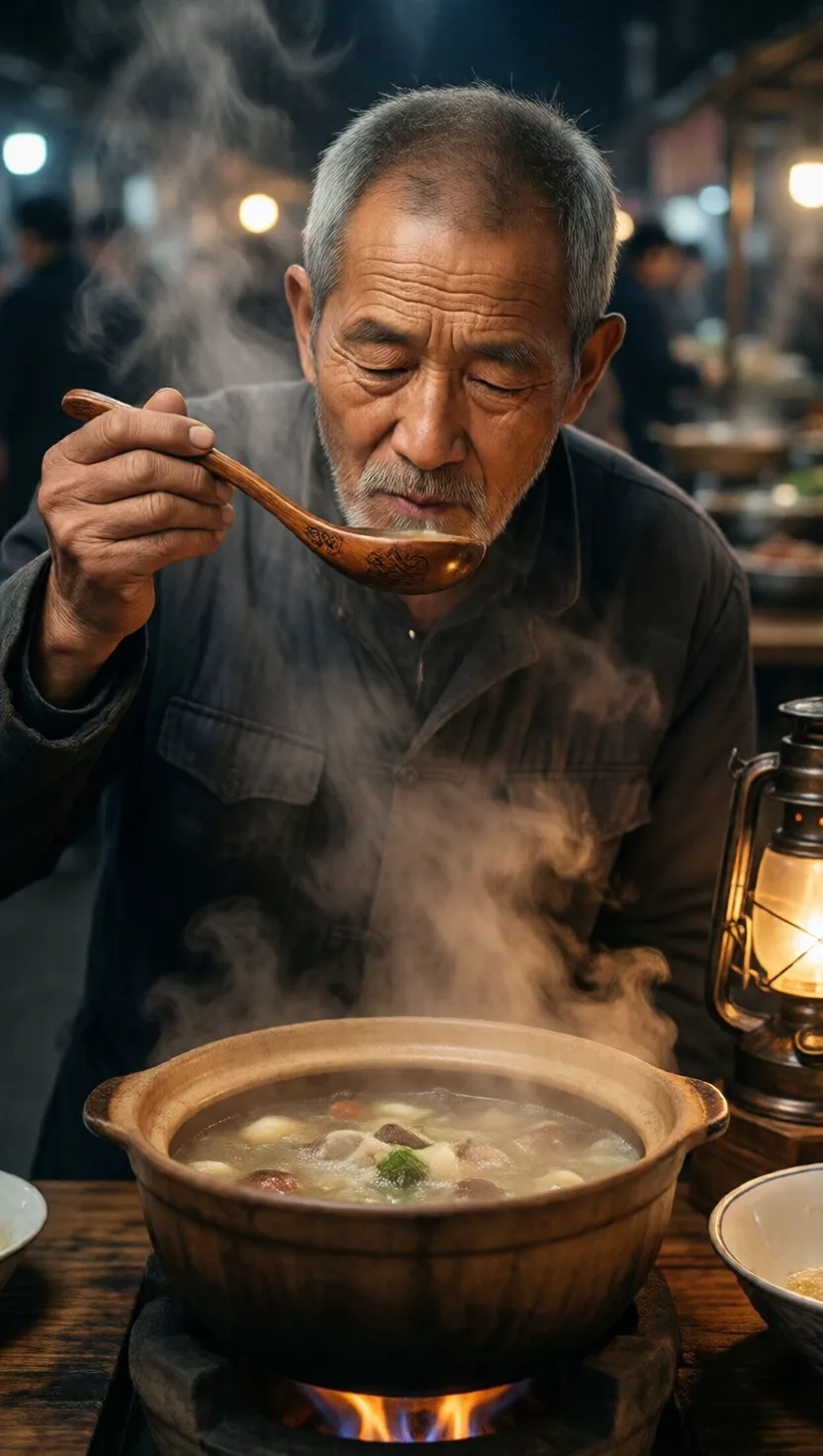
Contest night in the village: five cooks, five steaming pots, one iron pot of coins to share. No jury this year — the crowd's cheering will cut the prize into slices. By midnight, the cook who was only a little better holds nearly all of it, yet even the burnt stew earns two coins. What rule was the street secretly running?
Raw scores make terrible slices

Raw scores make terrible slices

Ask the tasters to rate each dish and you get numbers on any scale — this stew a three, that one below zero. You can't hand a cook a negative slice, and slices that ignore each other won't add up to one whole pot. A fair split needs every share positive, all of them summing to one. The cheering, it turns out, performs that conversion by itself.
Cheering feeds on cheering

Cheering feeds on cheering

Watch the street work. Every cook starts with a few loyal fans, and newcomers drift toward whichever stall is already loudest — so cheer compounds on itself all evening. A dish one notch better doesn't collect one notch more noise; its crowd keeps doubling. Raise a score by a step and the roar doesn't add — it multiplies. And the pot will simply follow the roar.
Your slice: your roar over the whole street's roar

Your slice: your roar over the whole street's roar

pj=ezjkezkp_j = \frac{e^{z_j}}{\sum_k e^{z_k}}
Here is the village's whole rule in one line. Blow each raw score up exponentially — that's the compounding crowd — then divide by the street's total roar. Read it plainly: every slice comes out positive, and together the slices make exactly one pot. Now watch what that little exponential does to a tiny gap between two cooks.
A sliver of talent, a landslide of coins

A sliver of talent, a landslide of coins

Compare any two cooks and the split cares about one thing only: the gap between their scores. One notch apart, and one slice is nearly three times the other; three notches, and it's twenty to one. Under an exponential, close doesn't pay — the almost-best dish still loses badly. Which makes the fate of the burnt stew all the stranger.
Nobody ever walks away with zero

Nobody ever walks away with zero

The burnt stew's cheer is a whisper — but a whisper isn't silence, and an exponential never reaches zero. Every cook leaves with something. This splitting rule is softmax: raw scores — logits — become positive shares of one whole. A language model ends each guess this way, certainty spread over every possible next word, nothing ruled out. One question remains for the village.
🌱 Who should hold the cheering dial?

🌱 Who should hold the cheering dial?

Imagine the village could tune how fiercely cheer compounds. Damp it, and the slices flatten toward equal — every cook fed, no one truly honored. Sharpen it, and the winner takes nearly all — bold, and brittle. Every contest, every market, every model choosing its next word sits somewhere on that dial. Where would you set it?
tap →swipe ↑ for depthswipe ↓ to exit