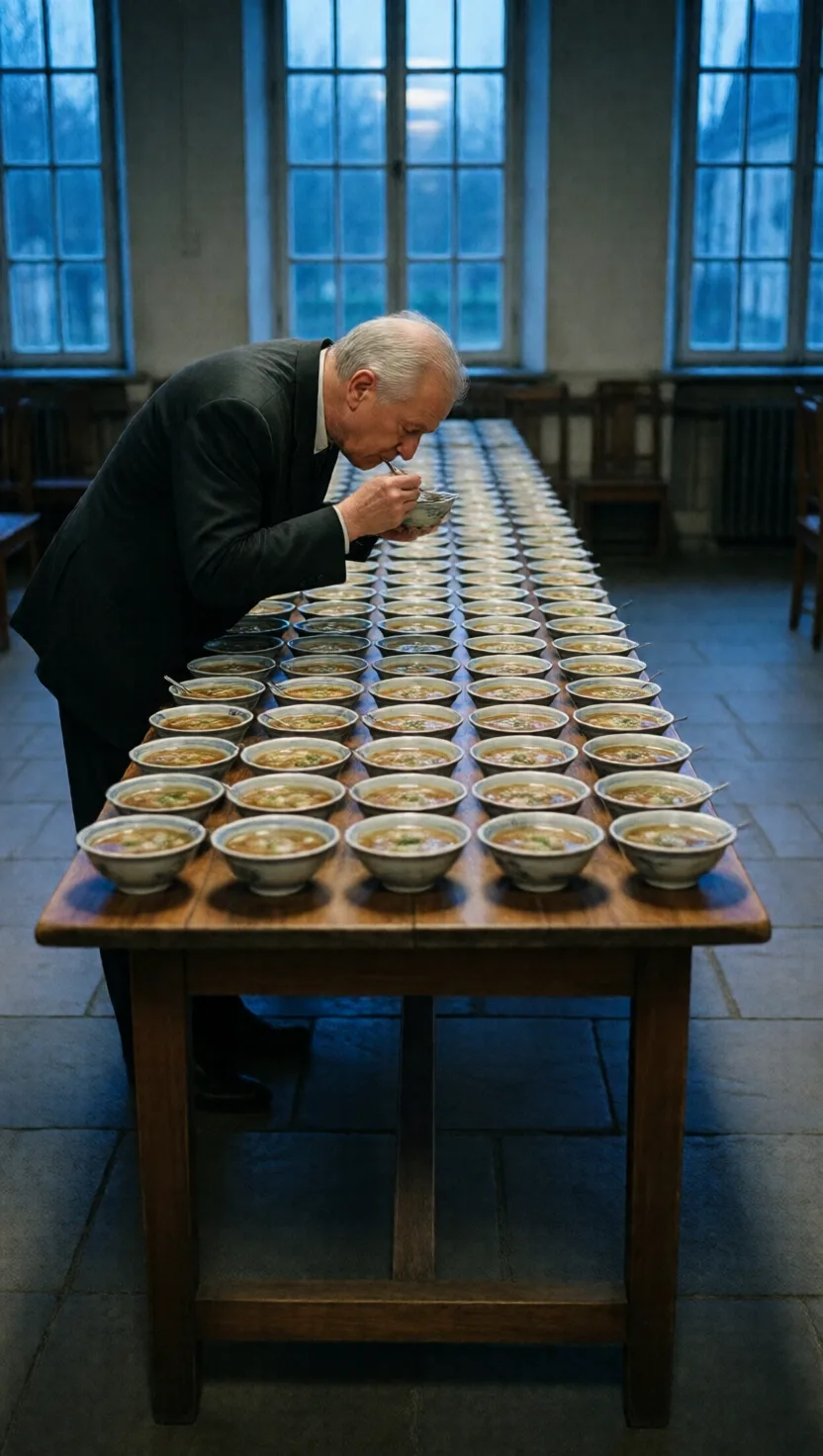
The taster who seasons soup for five hundred by the spoonful.

SRC·112 Source
Five hundred bowls, one tongue, one hour

Five hundred bowls, one tongue, one hour

In the royal kitchen, a copper cauldron taller than a child simmers for tonight's five hundred guests. Before the horns sound, the soup taster must answer one question: more salt, or not? The only verdict that truly counts is the whole pot — and she cannot drink the pot. So what can one small spoon honestly say about five hundred bowls?
Stir the pot, and one spoonful speaks for it

Stir the pot, and one spoonful speaks for it

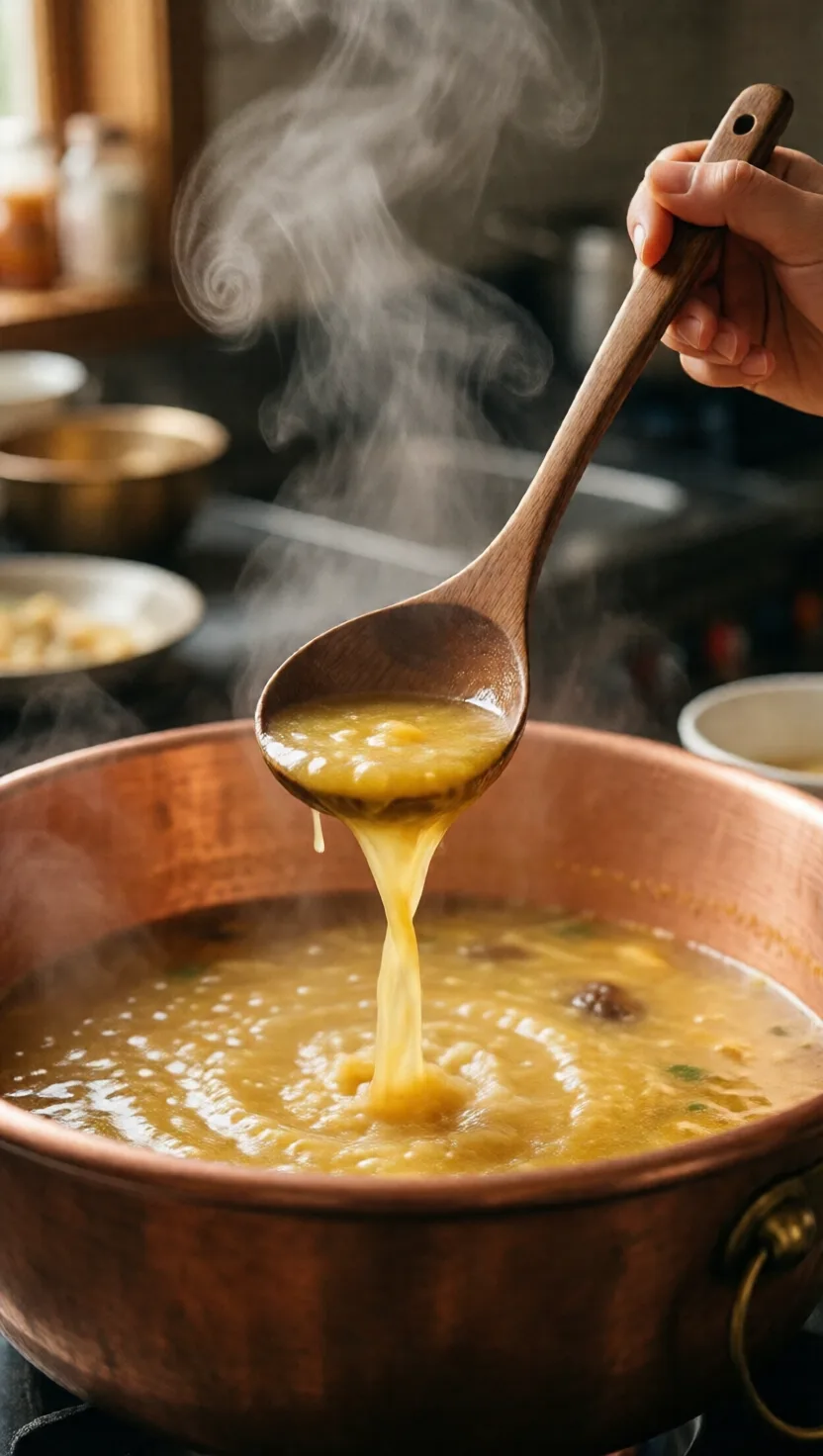
Her first rule is the stir. She drags the long ladle through the depths until the pot is one thing, top to bottom, then lifts a single spoonful. If the pot is truly mixed, that spoon is the pot in miniature — same broth, same salt, in one mouthful. She tastes: a touch flat. A pinch more salt, then. But the very next spoonful betrays her…
One unlucky peppercorn, and the spoon lies

One unlucky peppercorn, and the spoon lies

The next taste screams of pepper — she nearly reaches for the honey. Then she sees it: one whole peppercorn, unlucky and alone, sitting in her spoon. The pot is fine; the sample was cursed. Any single spoonful can lie like this — too salty here, too thin there — by pure luck of the dip. So should she trust spoons at all? The old steward says no…
The steward's perfect verdict comes too late

The steward's perfect verdict comes too late

The old steward's method is beyond reproach: ladle the entire pot into rows of little bowls, taste every single one, and average the verdicts. No peppercorn can fool him — his answer is exactly true. It is also exactly useless: by the time the last bowl is judged, the soup is cold and the guests are eating bread. A perfect verdict that arrives after the feast steers nothing…
Many quick spoonfuls, each a little wrong

Many quick spoonfuls, each a little wrong

Her way is humbler and faster. Taste a spoonful, nudge the salt, stir, taste again. Each spoon is a little wrong — but wrong in a different direction each time, and across rounds the errors mostly cancel. Ten cheap, imperfect verdicts before the horns sound steer the pot truer than one flawless verdict after them. And it turns out every learning machine seasons its soup her way…
A spoonful of the data: the mini-batch

A spoonful of the data: the mini-batch

1BiBi    1ni=1ni\frac{1}{|B|}\sum_{i\in B} \ell_i \;\approx\; \frac{1}{n}\sum_{i=1}^{n} \ell_i
A learning machine's true score is its average error over every example it owns — the whole pot. Rechecking that after each tiny adjustment is the steward's table: exact, far too slow. So it stirs the data and tastes a small random handful — a mini-batch. Below: the handful's average stands in for the pot's. Noisy, cheap, honest on average — enough to steer. One worry remains, though: who stirred the pot?
🌱 A spoonful only speaks for a stirred pot

🌱 A spoonful only speaks for a stirred pot

After service she scours the cauldron and considers the rule beneath the rule: her spoonfuls told the truth only because she stirred first. Ladle from an unstirred pot and you taste whatever floated to the top — a biased sample, confidently wrong. 🌱 Machines shuffle their examples for the same reason. Where in your own life are you tasting only the top of the pot?
tap →swipe ↑ for depthswipe ↓ to exit