How a model picks up a new task from the prompt — without changing a thing.

SRC·20 Source
It learns a new task from the prompt — and not one weight moves.

It learns a new task from the prompt — and not one weight moves.

Show it a task it was never trained on — a few examples, a new question — and it just does it. No fine-tuning. No gradient steps. Nothing inside it is rewritten. This is in-context learning: the model picks up the job from the prompt alone, in a single forward pass, then lets it go. Teaching, with nothing to install.
Usually learning means changing. Here, nothing changes.

Usually learning means changing. Here, nothing changes.

Δθ=0\Delta\theta = 0
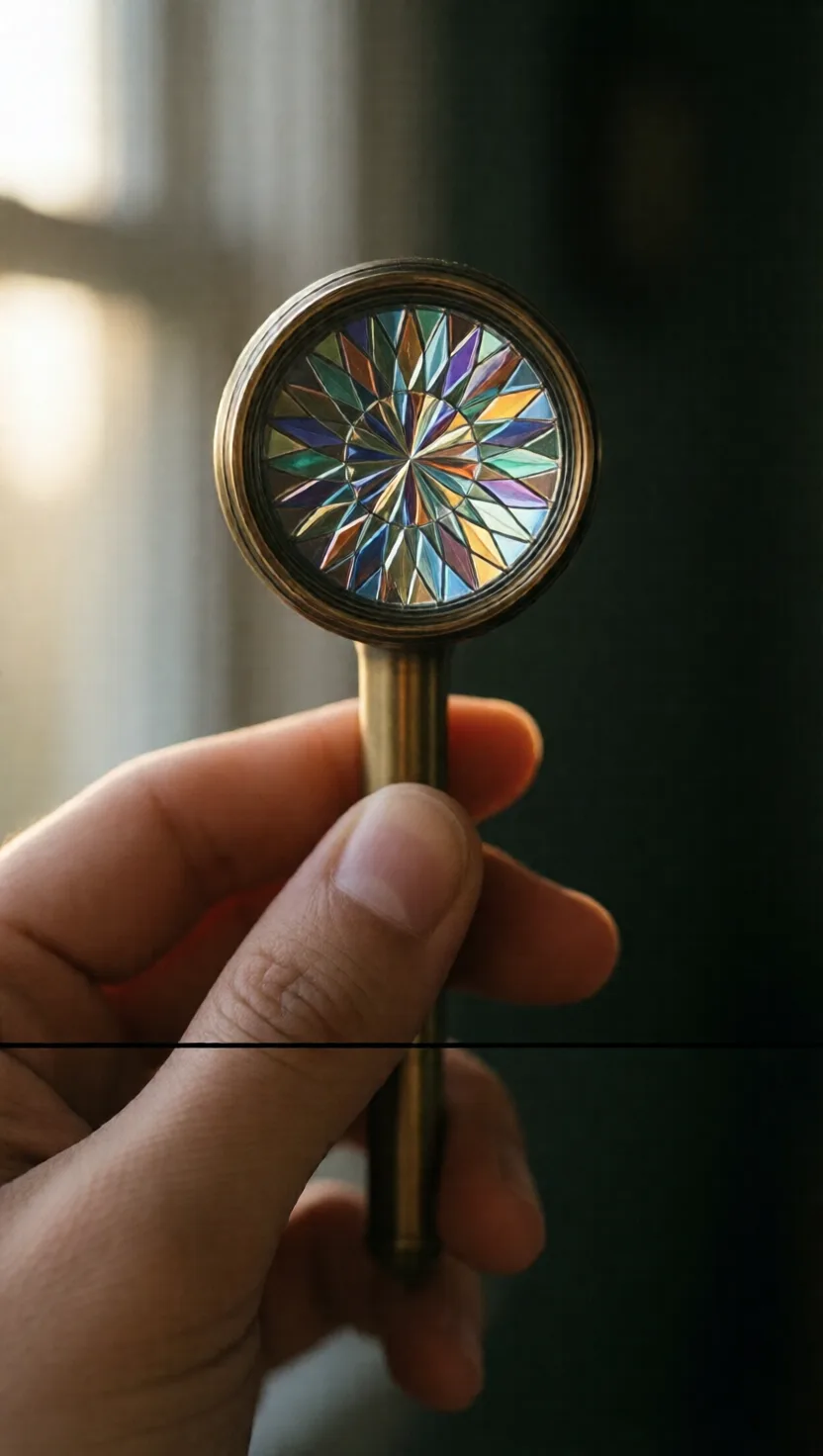
Training rewrites a model — gradient descent nudges a billion weights until it's better. In-context learning does none of that: the weights are frozen solid, Δθ = 0. So where does the new skill come from? Like a kaleidoscope: the mirrors and beads never change — give it a turn and a wholly new pattern appears, built only from what was already inside.
You don't tell it the rule. You show it a few examples.

You don't tell it the rule. You show it a few examples.

y^=argmaxy pθ ⁣(y(x1,y1),,(xk,yk),xq),θ fixed\hat{y} = \arg\max_{y}\ p_\theta\!\left(y \mid (x_1,y_1),\dots,(x_k,y_k),\,x_q\right),\quad \theta\ \text{fixed}
Lay down a handful of pairs — input, then answer — then a fresh input, all as one long prompt. The model just continues the pattern. You never stated the rule; the examples are the instruction. Like an impressionist: give them a few lines in someone's voice and they carry on in it perfectly — nobody wrote down how that voice works. Same next-word engine, newly aimed.
It isn't learning the task. It's finding one it already has.

It isn't learning the task. It's finding one it already has.

p(yx,D)=p(yx,T)p(TD)dTp(y \mid x, D) = \int p(y \mid x, T)\, p(T \mid D)\, dT
Pretraining already walked it past a thousand tasks like yours. The examples don't teach a new skill — they tell it which skill to run. Formally, its answer averages over every task it might be doing, weighted by how well each fits your demonstrations. Like a janitor's keyring: you already carry every key — the examples just say which one opens this door.
Each example rules tasks out. The first few do the most.

Each example rules tasks out. The first few do the most.

p(TDk+1)p(TDk)p(xk+1,yk+1T)p(T \mid D_{k+1}) \propto p(T \mid D_k)\, p(x_{k+1},y_{k+1} \mid T)
Every new demonstration reweights the field: tasks that predicted it well rise, the rest fade. So more examples sharpen the guess — but with diminishing returns. A handful usually does most of the work, and piling on more barely moves it (and can even confuse it). Like focusing binoculars: the first turns snap the scene sharp; after that, you're barely turning at all.
The wild part: the forward pass may be doing the learning.

The wild part: the forward pass may be doing the learning.

w^=w0ηwi(wxiyi)2,y^q=w^xq\hat{w} = w_0 - \eta\,\nabla_{w}\textstyle\sum_{i}\left(w^\top x_i - y_i\right)^2,\qquad \hat{y}_q = \hat{w}^\top x_q
Strip it to a toy — a simple linear task, simplified attention — and you can read an actual learning step out of the math: one pass fits a throwaway model to your examples, then predicts. Like a card counter: from the few cards already shown, they quietly fit the odds in their head — a whole calculation hidden inside one glance. Proven for the toy case; a leading guess for the real thing.
The prompt is a program. The machine never changes.

The prompt is a program. The machine never changes.

No retraining, no new copy, no weights touched — you reprogram it with what you set in front of it, and the next prompt reprograms it again. The whole skill lives in the input. Like a chameleon: the animal itself never changes — set it on a new background and it becomes that color, instantly, then the next.
🌱 It learned for a moment. Then the window closed.

🌱 It learned for a moment. Then the window closed.

Whatever it picked up lived only in this context. Close the window and it's gone — the model is exactly as it was, holding nothing. So was that learning, or only remembering long enough to answer? And if a skill can appear with the prompt and vanish with it, where was the skill the whole time it slept?
tap →swipe ↑ for depthswipe ↓ to exit